


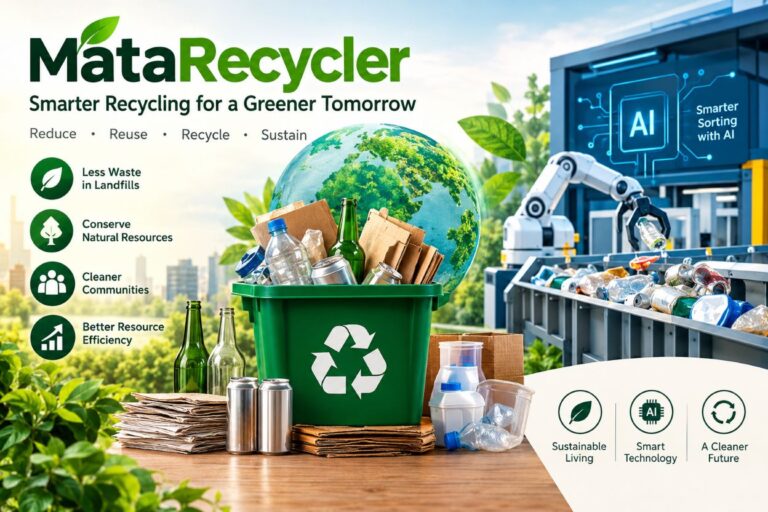
MataRecycler is a name associated with recycling, environmental awareness, waste reduction, and sustainability information. The website MataRecycler.com presents itself as an educational platform that shares guidance about responsible recycling and environmentally friendly practices. Its stated purpose is to make information about waste management and resource conservation easier to understand. However, the name also appears in online articles describing advanced recycling technology, including artificial intelligence, smart bins, and automated waste sorting.
These descriptions need to be considered separately. The website’s published information establishes its role as a content platform, but it does not establish that a commercial recycling machine or AI-powered system operates under the same name. MataRecycler+1
Recycling itself is an established process that helps recover useful materials from discarded products. Modern facilities also use sensors, robotics, and computer systems to improve sorting. These technologies can support more efficient waste management when implemented correctly. Understanding the difference between a website, a proposed concept, and a verified commercial product is therefore essential when examining MataRecycler.
In 2026, the most useful way to understand this subject is to examine its stated purpose, the principles of modern recycling, the role of technology, and the evidence behind specific claims. This approach provides a clearer picture of where MataRecycler fits into the wider sustainability discussion.
What Is MataRecycler?
The Purpose Behind MataRecycler
MataRecycler.com describes its mission as promoting responsible recycling, sustainable habits, and environmental awareness. Its About Us page outlines several educational goals, including explaining recycling processes, sharing waste reduction methods, and helping readers understand environmentally responsible choices. The platform presents this information for individuals, businesses, and communities.
The general idea behind the name is connected to recovering useful resources instead of allowing reusable materials to become unnecessary waste. This principle is important because many discarded products still contain materials that can be processed and used again. Paper, glass, metals, and certain plastics are common examples.
However, the website’s stated purpose should not be confused with proof of a specific recycling service. The available description identifies an informational platform rather than a clearly documented manufacturer of recycling equipment. MataRecycler+1
For readers, this distinction makes the subject easier to understand. Educational content can explain environmental problems and possible solutions without directly providing the machinery or services needed to implement them. MataRecycler is best approached through that distinction unless further verifiable information establishes a different role.
Is MataRecycler a Website or a Recycling Technology?
The clearest verified association is with a website that publishes informational content. Some third-party articles describe MataRecycler as a smart recycling system that combines sensors, artificial intelligence, cameras, and automated sorting equipment. Nevertheless, the available material does not establish one officially documented product with a confirmed manufacturer, technical specifications, or independently verified installations. Tell Magazine+2
This does not mean that smart recycling technology is imaginary. AI-assisted sorting is already used in real recycling operations. Companies such as AMP and TOMRA have documented technologies designed to identify and separate materials more effectively. AI Recycling Automation Company+1
The important question is whether a particular technology has been demonstrated under the MataRecycler name. Without reliable product documentation, claims about its equipment or performance remain unconfirmed.
Readers should therefore distinguish between the real environmental technology described by established providers and the broader claims associated with MataRecycler. That distinction helps prevent unsupported statements from being treated as proven facts.
How Modern Recycling Systems Work
Collection and Initial Waste Separation
The recycling process usually begins when households, businesses, and industries separate reusable materials from general waste. Collection services then transport these materials to suitable processing facilities. The exact process depends on the local recycling system and the types of materials accepted.
Some communities collect paper, cardboard, metal cans, glass, and selected plastics together. Others require residents to separate different materials before collection. Both approaches depend on effective sorting and clear disposal instructions.
At a recycling facility, workers and machines inspect the incoming material. Large unwanted objects may be removed first. The remaining waste moves through equipment designed to separate materials according to their physical or chemical properties.
Contamination can make this stage more difficult. Food residue, hazardous objects, plastic bags, and unsuitable packaging may interfere with processing. As a result, separating waste correctly at home or work can improve the quality of the materials entering a recycling facility. The US Environmental Protection Agency recommends checking local recycling rules and keeping accepted recyclables clean and dry. US EPA+1
Sorting Materials With Modern Technology
Traditional recycling facilities often rely on a combination of manual inspection and mechanical equipment. Magnets can separate certain ferrous metals, while other machines use differences in size, shape, weight, or material properties. These methods help facilities process large amounts of mixed waste.
Modern systems can add optical sensors, cameras, artificial intelligence, and robotic arms. Cameras capture images of moving objects, while software analyses visible features to identify particular materials. The equipment can then direct selected objects toward separate collection points.
TOMRA, for example, documents deep-learning technology that identifies objects using trained computer models. Its systems are designed to improve material separation and help operators recover valuable resources. TOMRA+1
These capabilities demonstrate how technology can improve recycling operations. However, they should not automatically be attributed to MataRecycler. No verified technical specification currently establishes that MataRecycler owns or operates equivalent equipment.
Processing Recovered Materials
Sorting is only one stage of recycling. After separation, suitable materials must undergo additional processing before manufacturers can use them again.
Paper is generally broken down into fibres, cleaned, and prepared for manufacturing. Glass is sorted by type and colour where required, then processed into material suitable for new glass products. Metals are separated, prepared, and often melted for reuse. Plastics require careful identification because different polymer types have different processing requirements.
The quality of the recovered material matters. A recycling facility may successfully collect a large quantity of waste but still produce material that requires further cleaning or cannot meet a manufacturer’s standards.
Effective recycling therefore depends on the entire process, from collection to manufacturing. Better sorting equipment can help, but it cannot guarantee that every discarded object will become a new product. Market demand, contamination, processing costs, and material quality all influence the final result.
Potential Benefits of the MataRecycler Concept
The following benefits relate to established recycling principles and technologies. They should not be interpreted as measured results from a verified MataRecycler product.
Reducing Waste Sent to Landfills
One important purpose of recycling is to recover materials that might otherwise be discarded. When suitable materials are collected and processed, less waste may need to be sent to landfills or other disposal facilities.
Landfill space is limited in many areas, while poorly managed waste can create environmental and public health concerns. Recovering useful materials can reduce pressure on disposal systems, provided the recovered products have suitable processing routes and markets.
A recycling-focused approach also encourages people to think more carefully about what they throw away. Instead of treating every unwanted item as useless, households and businesses can identify products that can be reused, repaired, donated, or recycled.
Nevertheless, recycling alone cannot solve every waste problem. Some products contain mixed materials that are difficult to separate. Others may be contaminated or lack a practical recycling route. Preventing unnecessary waste remains an important part of responsible resource management. The EPA’s waste hierarchy places waste reduction and reuse ahead of recycling. US EPA+1
Conserving Natural Resources
Manufacturing new products often requires raw materials extracted from the natural environment. These resources include timber, minerals, petroleum-based feedstocks, and other materials used in industrial production.
Recycling can reduce demand for some virgin resources by supplying recovered materials to manufacturers. For example, recycled metals can serve as feedstock for new metal products, while recovered paper fibres can be used to produce certain paper and cardboard goods.
The actual environmental benefit depends on the material and the process involved. Collection, transportation, cleaning, and manufacturing all consume resources. Even so, recovering usable materials can reduce the need for some forms of extraction and processing.
This is one reason sustainability programmes often combine recycling with product reuse and waste prevention. A durable item that remains in use for several years may avoid more waste than a disposable product that is recycled after a single use.
The broader principle associated with MataRecycler is therefore most useful when viewed as part of a complete resource management strategy. Recycling works best when people also make thoughtful purchasing decisions and avoid unnecessary consumption.
Supporting Cleaner Communities
Waste management affects the cleanliness and appearance of residential areas, public spaces, workplaces, and commercial districts. When waste is collected and handled properly, communities can reduce litter and improve the management of reusable materials.
Recycling programmes can also create opportunities for public education. Schools, businesses, and community groups can explain how to separate waste, reduce packaging, and dispose of unwanted products responsibly.
However, recycling infrastructure must be practical and accessible. Residents need suitable collection points, clear instructions, and reliable collection schedules. If a recycling system is confusing or inconvenient, people may place unsuitable materials in recycling containers or discard useful items with general waste.
Educational platforms such as MataRecycler can contribute by explaining environmental principles in accessible language. Their value depends on the accuracy and usefulness of their information. Local waste authorities remain the appropriate source for confirming which materials are accepted in a particular area.
Improving Resource Efficiency in Businesses
Businesses produce many kinds of waste, including cardboard packaging, office paper, metal scraps, plastic wrapping, and electronic equipment. A structured waste management programme can help identify materials that should be reused, recycled, or handled through specialist services.
For example, a warehouse can separate clean cardboard from general waste. A manufacturing facility may recover metal offcuts for processing. An office can reduce paper consumption and arrange suitable collection for electronic equipment.
Modern tracking systems can help organisations measure waste volumes and identify recurring problems. When combined with reliable sorting processes, these records can support better purchasing decisions and reduce avoidable disposal costs.
Still, the financial results depend on local collection charges, the value of recovered materials, equipment costs, and staff time. Businesses should calculate these factors before investing in a new recycling system.
There is no verified financial performance data establishing that MataRecycler itself delivers particular savings. Any organisation considering a technology associated with this name should request documented results and compare them with its current waste management costs.
The Role of Artificial Intelligence in Recycling
How AI Can Identify Different Materials
Artificial intelligence can help recycling facilities recognise objects that are difficult to separate using basic mechanical methods. A computer vision system analyses images and compares visible features with patterns learned during training. These features may include an object’s shape, colour, size, packaging design, and other identifiable characteristics.
The software then helps determine which objects should be separated from the moving waste stream. Depending on the equipment, a robotic arm, air jet, or another mechanism performs the physical sorting.
This technology is not limited to theoretical research. AMP develops AI-powered waste sorting systems, while TOMRA uses deep learning in its recycling equipment. Both companies document real applications of automation and material identification. AI Recycling Automation Company+1
AI can also help operators understand what enters a recycling facility. Information about material composition and sorting results may reveal where contamination occurs or where equipment settings need adjustment.
However, recognition accuracy depends on real operating conditions. Dirty packaging, overlapping objects, changing materials, damaged labels, and poor camera visibility can create difficulties. Human supervision, equipment maintenance, and quality checks remain important.
Can MataRecycler Be Confirmed as an AI Recycling System?
Some online descriptions associate MataRecycler with smart bins, automated sorting, digital monitoring, and AI-based material recognition. These descriptions resemble capabilities found in the wider recycling technology industry. However, similarity to existing technology does not establish that a specific MataRecycler product exists.
The available evidence does not confirm a named manufacturer, independently tested machine, published technical manual, or verified commercial installation under this name. Tell Magazine+1
A reliable assessment would require more than a detailed online description. Evidence could include a product model, identifiable manufacturer, demonstration footage, technical specifications, independently reviewed test results, and confirmation from an organisation using the equipment.
Performance figures also require context. A sorting accuracy percentage may refer to a particular material, controlled test, or operating condition. It should not be applied to every waste stream without supporting evidence.
Until such information becomes available, MataRecycler should not be presented as a proven AI-powered recycling machine. The technology is real, but its connection to this particular name remains unverified.
Challenges and Limitations of Modern Recycling
Contamination and Material Quality
Contamination is one of the major challenges facing recycling facilities. A load of recyclable material may contain food residue, unsuitable plastics, hazardous objects, or materials that cannot be processed together.
These unwanted items can reduce the quality of recovered materials. In some cases, contamination can make an entire batch harder or more expensive to process.
Clear instructions can help prevent these problems. Households should check local rules, empty containers when required, and avoid placing items in recycling bins simply because they look recyclable.
Businesses can improve results by providing separate containers for different waste types. Staff training and regular inspections can also reduce mistakes.
Equipment Costs and Maintenance
Advanced recycling equipment can require significant investment. Facilities may need cameras, sensors, conveyor belts, sorting mechanisms, software, electrical systems, and trained operators.
Installation is only part of the cost. Organisations must also consider repairs, replacement parts, cleaning, software updates, staff training, and downtime.
Smaller communities may find advanced automation difficult to justify if they do not generate enough suitable material. In these situations, better collection systems and simpler mechanical methods may offer greater value.
Any proposed MataRecycler technology would need to demonstrate how its costs compare with existing alternatives. Without confirmed pricing or performance records, its commercial value cannot be assessed reliably.
Differences in Local Recycling Rules
Recycling systems vary by location. A material accepted by one municipality may be rejected by another because of differences in equipment, processing capacity, and local markets.
Plastic packaging is a useful example. Different plastics can look similar but behave differently during processing. Some local programmes accept particular containers but exclude flexible packaging or mixed-material products.
For this reason, general recycling advice should not replace local instructions. A reliable educational resource should explain broad principles while encouraging readers to verify specific disposal requirements.
Environmental Trade-Offs
Recycling can conserve resources, but the process also uses energy, water, transport, and industrial equipment. The environmental outcome depends on the material being recovered and the efficiency of the entire system.
Transporting small quantities of waste over long distances may reduce the benefits of recovery. Likewise, processing a heavily contaminated material can consume resources without producing a useful final product.
These trade-offs do not make recycling pointless. Instead, they show why waste prevention, reuse, efficient collection, and suitable processing must work together.
The strongest approach is to evaluate environmental outcomes across the full life cycle rather than assuming that every recycling activity delivers the same benefit.
How to Evaluate MataRecycler Information in 2026
Check the Source and Its Evidence
When evaluating information about MataRecycler, begin with the website or organisation making the claim. Look for a clear explanation of its activities, identifiable ownership, and evidence supporting its statements.
A website that publishes educational material has a different role from a business that manufactures industrial equipment. Understanding this difference helps readers judge whether a claim is relevant and adequately supported.
For technology-related claims, look for specifications, product demonstrations, independent testing, and confirmed customer installations. If an article provides impressive statistics, check whether it explains how those numbers were measured.
Be especially cautious when several websites repeat identical claims without identifying an original source. Repetition does not make a statement independently verified.
Look for Independent Performance Results
A credible recycling technology should be assessed through measurable results. These might include the quantity of material recovered, contamination levels, processing speed, energy use, operating costs, and the quality of the final material.
Results should also explain the conditions under which the equipment was tested. A machine that performs well with clean, clearly separated objects may produce different results when handling mixed household waste.
Independent assessments can help determine whether reported benefits are realistic. Buyers should seek references from existing customers and ask whether the technology has been tested under conditions similar to their own facilities.
For MataRecycler specifically, reliable public evidence establishing these details has not been identified in the material reviewed for this article. Its claimed technical capabilities should therefore remain separate from the proven capabilities of other recycling providers.
Consider Privacy and Data Security
Digital recycling systems may collect operational information through cameras, sensors, software, and connected monitoring tools. Depending on the design, this information might include waste volumes, material categories, equipment performance, or images captured around collection points.
Organisations considering such systems should understand what information is collected and how it is stored. They should also check who can access the data, how long records are retained, and whether the equipment captures identifiable information unnecessarily.
These questions are particularly important when installing connected equipment in public places, offices, schools, or residential buildings.
There is no verified basis for attributing particular data collection practices to MataRecycler as a commercial product. These considerations apply to smart recycling systems generally and would need to be assessed against the documentation of any actual product.
Practical Ways to Make Recycling More Effective
Start With Waste Reduction
The easiest waste to manage is often waste that never needs to be created. Before purchasing a new product, consider whether an existing item can serve the same purpose.
Reusable containers, durable shopping bags, refillable products, and repairable equipment can reduce unnecessary waste. Businesses can also review packaging choices and purchase supplies in quantities that match actual needs.
These changes may appear small, but they can reduce the volume of material entering waste collection systems.
Separate Materials Correctly
Place accepted recyclable materials in the appropriate containers. Keep food waste, liquids, and unsuitable items out of recycling bins whenever local instructions require this.
Flattening cardboard can save space during collection. Batteries, electronics, chemicals, and other potentially hazardous items may require dedicated collection arrangements rather than ordinary household recycling.
Always confirm the relevant rules before disposing of unusual materials. Correct separation helps protect workers, reduce contamination, and improve the quality of recovered resources.
Measure Progress Over Time
Households can begin by noticing which products create the most waste. Businesses can record the quantities of different materials they discard and identify opportunities for reuse.
Useful measurements include the amount of waste produced, the proportion collected separately, contamination rates, and disposal costs. Reviewing these figures regularly can reveal whether a recycling programme is improving.
For organisations, clear targets can make environmental initiatives easier to manage. However, targets should be based on realistic measurements rather than unsupported promises.
MataRecycler’s broader sustainability theme aligns with these practical principles. Their success depends on consistent behaviour, suitable infrastructure, and accurate information rather than the name of a particular platform.
Conclusion
MataRecycler sits at the intersection of recycling education, sustainability discussions, and online claims about modern waste management. Its website describes a mission centred on environmental awareness and practical recycling information. Meanwhile, some third-party publications present the same name as an advanced recycling system.
The available evidence does not establish that these descriptions refer to one verified commercial technology. It is therefore important to separate the website’s stated purpose from claims about machinery, artificial intelligence, mobile applications, and measurable performance.
Modern recycling continues to develop through automation, material recognition, improved collection systems, and better processing methods. Documented providers demonstrate that these innovations can support resource recovery when implemented appropriately.
For households and businesses, the most useful steps remain straightforward: prevent unnecessary waste, reuse suitable products, separate accepted materials correctly, and follow local disposal guidance. Technology can support these efforts, but reliable evidence and practical implementation determine its real value.
Ultimately, MataRecycler is best understood through the information that can be verified today. A clear distinction between established recycling practices and unconfirmed product claims provides a stronger foundation for informed environmental decisions in 2026.
Frequently Asked Questions About MataRecycler
What Is MataRecycler?
MataRecycler is the name of a website that describes itself as an informational platform focused on recycling, sustainability, and environmental awareness. Other online articles associate the name with smart recycling technology, but a specific commercial system under that name has not been independently verified.
Is MataRecycler a Real Company?
The existence of MataRecycler.com is verifiable, but the available information does not establish it as a documented manufacturer of recycling machinery. Its published About Us page describes an educational platform. Its ownership and any connection to a separate commercial recycling technology remain unconfirmed. MataRecycler+1
Does MataRecycler Use Artificial Intelligence?
Some third-party articles describe MataRecycler as an AI-based recycling system. However, no sufficiently verified technical documentation establishes that the website operates or owns such a system. AI-assisted waste sorting is a genuine technology, but its existence elsewhere does not confirm its use by MataRecycler.
What Are the Main Benefits Associated With MataRecycler?
The main themes associated with MataRecycler include recycling awareness, waste reduction, resource conservation, and sustainable practices. These are established environmental goals. However, specific financial savings, sorting accuracy figures, or environmental performance results cannot be attributed to MataRecycler without supporting evidence.
Is MataRecycler Safe to Use?
Reading an informational website is different from purchasing or installing recycling equipment. Readers should assess the accuracy of its articles and verify important disposal advice with their local waste authority. Anyone considering a commercial product should confirm the supplier’s identity, technical documentation, security practices, and customer references.
Is MataRecycler Available as a Mobile App?
The information reviewed does not establish an official MataRecycler mobile application with verified features. Claims about an app, reward programme, or connected recycling service should be treated cautiously until an official application listing and identifiable developer can be confirmed.
Can Businesses Benefit From MataRecycler?
Businesses can benefit from accurate recycling information by improving waste separation, reducing unnecessary purchases, and identifying reusable materials. However, there is insufficient verified evidence to establish that MataRecycler provides a dedicated commercial recycling service or delivers specific business savings.
What Is the Future of MataRecycler?
Its future depends on how the platform develops and whether its identity and activities become more clearly documented. It could continue serving as an informational resource. Any proposed connection to commercial recycling technology would require further evidence, including identifiable products, technical documentation, and verified deployments.

1 Comment
Pingback: Kinervus Guide: Modern Physical Therapy & Brain Health Solutions