



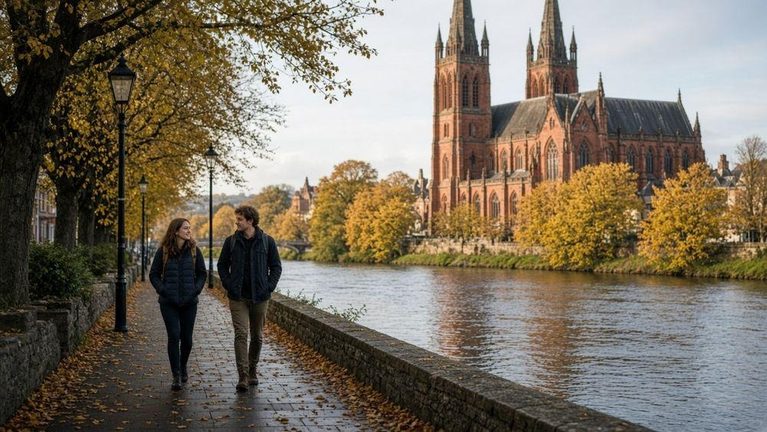
Anyone who has driven the A9 north knows the feeling. The hills open up, the Moray Firth appears, and suddenly you are somewhere that feels very different from the rest of Britain. Inverness is the gateway to the Highlands, but it is also a small, friendly city with enough history, food and scenery to fill a proper weekend.
So, is Inverness worth visiting in 2026? For most travellers the answer is yes, as long as you plan around the weather, the transport links and the fact that some of the best sights sit just outside the centre. This guide covers what to see, where to eat, when to go and how to keep your weekend light.
Arriving in Inverness: Getting Your Bearings
Most visitors arrive by train at Inverness station on Academy Street, by coach at the bus station a few minutes away, or through Inverness Airport at Dalcross, roughly 20 minutes from town by bus. The centre is compact, and almost everything you need on day one is within a 15-minute walk.
The awkward part is timing. Many guesthouses do not open their rooms until mid-afternoon, and checkout on your last day is usually mid-morning, which can leave you with hours to fill and a suitcase to drag along. Plenty of travellers now drop their cases at a local luggage storage point near the station instead. Options such as Radical Storage Inverness work with nearby shops and hotels, so you can leave a bag for the day and start exploring straight off the train.
Why Inverness Is Worth Visiting: The City Centre on Foot
Start with the River Ness. The riverside paths on both banks are flat, well lit and lovely in any season, with the red sandstone spires of St Andrew’s Cathedral on the west bank and the castle on the hill above the east bank. Follow the river south for about 20 minutes and you reach the Ness Islands, a string of wooded islets linked by Victorian footbridges. It is one of the calmest walks in any Scottish city.
Back in town, the Victorian Market has been given a new lease of life with a food hall and independent stalls under its old glass roof. Leakey’s Bookshop on Church Street, set inside a former Gaelic church, is worth a browse even if you do not plan to buy anything. Inverness Castle has been going through a major redevelopment into a visitor attraction, so check what is open before you walk up, though the viewpoint outside still gives one of the best panoramas over the river.
Day Trips: Loch Ness, Culloden and the Black Isle
Part of what makes Inverness worth visiting is how much lies within half an hour of it. Loch Ness begins just south-west of the city. Drive or take a bus along the A82 to Urquhart Castle for the classic view, or follow the quieter south shore road to Dores, where a pebble beach looks straight down the loch.
Culloden Battlefield, about five miles east, is a sobering and moving stop. The National Trust for Scotland visitor centre explains the 1746 battle well, and the open moor says more than any display. Nearby, the Clava Cairns are a group of Bronze Age burial cairns and standing stones that most people have entirely to themselves.
If you have a car, cross the Kessock Bridge to the Black Isle. At Chanonry Point near Fortrose, bottlenose dolphins often feed close to the shore on a rising tide, and you can watch them for free from the beach.
Where to Eat and Drink in Inverness
Inverness punches above its size for food. Seafood from the north and west coasts shows up on most menus, and you will find good Highland venison, lamb and beef too. Book ahead for the popular riverside restaurants on Friday and Saturday nights, as tables fill quickly in summer.
For something more relaxed, the Black Isle Brewery bar on Church Street serves organic beers alongside wood-fired pizza. Hootananny, a few doors away, has traditional music sessions most nights and a lively crowd. Whisky lovers can sample drams from Speyside and the northern Highlands in several city bars, and a distillery tour is easy to add on the way to or from the city.
When to Visit Inverness
There is no bad time to go, but each season feels different:
- Spring (April to May) brings fresh greenery, fewer crowds and fairly reliable dry spells.
- Summer (June to August) offers very long days and the best weather, with higher prices and busier roads.
- Autumn (September to October) means golden trees along the river and good walking weather.
- Winter (November to March) is quiet and atmospheric, with short days and the chance of snow on the hills.
Midges can be a nuisance from late spring to late summer in rural spots, so pack repellent if you plan to walk by the lochs at dusk.
Practical Tips for a Smooth Inverness Weekend
A little planning goes a long way in the Highlands, where distances look short on a map but roads are slow and buses less frequent than in big cities. These tips help:
- Book trains early. The Caledonian Sleeper from London Euston is a memorable way to arrive, and advance fares on the Highland Main Line from Edinburgh and Glasgow are much cheaper.
- Hire a car for a day if you want Loch Ness, Culloden and the Black Isle in one go, as tours fill up in summer.
- Pack layers and a waterproof whatever the forecast says. Highland weather changes by the hour.
- Travel light on your departure day. Leaving your bag at a storage point means you can fit in one last walk or lunch before the train.
- Carry a little cash for rural cafes and car parks, although most places in the city take cards.
Conclusion
Inverness rewards travellers who treat it as a destination rather than a quick stop on the way somewhere else. The riverside walks, the Victorian Market, the live music and the food scene easily fill a day, while Loch Ness, Culloden and the Black Isle turn it into a full weekend. Plan around the season, book trains and tables early, and keep your luggage from slowing you down. If you have been asking whether Inverness is worth visiting in 2026, the honest answer is that a weekend here is rarely enough, and most people leave planning their next trip north.
