
A photograph of somebody riding an elephant is not a picture of a holiday. It is an advertisement for an industry.
Travel content works by creating desire, which is the whole point of it. Somebody sees an image, wants that experience, and books something similar. That mechanism is value-neutral when the subject is a beach or a railway journey, and it is not neutral at all when the subject is a wild animal doing something it would never do.
The experiences behind the most shareable wildlife images are frequently the ones with the worst practices attached, because an animal that tolerates close human contact has usually been made to tolerate it.
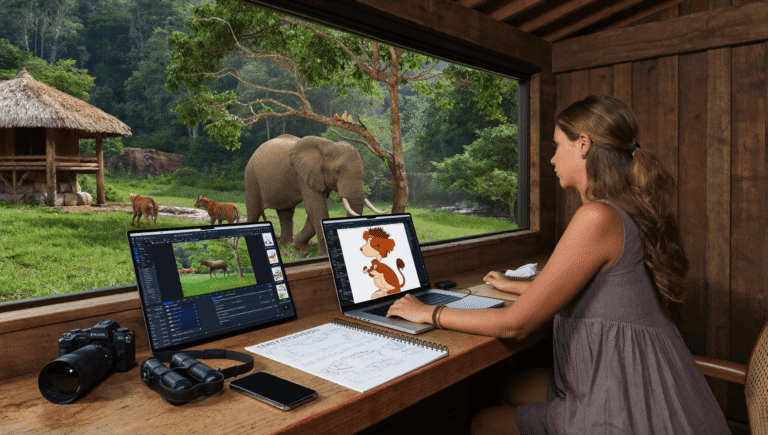
An AI Animal Generator has a narrow role here, which Higgsfield provides in the browser, and understanding what sits behind certain images matters considerably more than the production question.
Why Does the Image Create the Problem?
Because demand follows imagery, directly and measurably.
An experience appears in travel content, more people request it, and operators expand to meet the demand. That chain works the same way whether the experience is a cookery class or something an animal is being forced to do.
- Images drive bookings, which is why operators want them
- Shareable experiences expand faster than unshareable ones
- Close contact photographs well and is rarely voluntary
- The viewer sees one moment, not the conditions around it
- No AI Animal Generator image carries that consequence, which is its one advantage
The one-moment problem is the heart of it. A photograph shows a few seconds of an animal’s life and tells you nothing about the other twenty-three hours, the training, or what happens when the tourists leave.
Publishers have more influence here than individual travellers do. One article reaches thousands of people choosing what to book.
What Sits Behind the Most Shareable Images?
Practices that are well documented and rarely mentioned in the caption.
- Elephant riding, which no AI Animal Generator image could ever justify
- Tiger photographs, where close contact typically involves sedation or declawing
- Photo props, including primates kept chained and slow lorises with teeth removed
- Walking with lions, which feeds cubs into a documented commercial pipeline
- Performing marine mammals, kept in enclosures a fraction of their natural range
The slow loris case is the clearest and least known. They are venomous, so their teeth are cut out to make them safe to handle for photographs, which frequently kills them through infection.
The lion walking case has been traced repeatedly by conservation organisations. Cubs used for tourist interaction age out of that role, and what happens afterwards is not what visitors were told.
None of this is hidden information. It is simply absent from the caption.
What Should Travel Content Show Instead?
Animals at a distance, habitat, and the people who live there.
- Wild animals at a respectful distance, which is what wildlife looks like
- Habitat and landscape, which is usually more beautiful anyway
- Guides and local communities, who are the actual expertise
- Genuine sanctuaries, with their standards named
- An AI Animal Generator illustration where no ethical photograph exists
The distance point is both ethical and aesthetic. A long lens photograph of an animal behaving naturally is a better image than a close one of an animal tolerating a stranger.
Naming the standards matters. Saying an organisation does not permit riding, contact or breeding tells readers what to look for elsewhere, which is worth more than a recommendation.
Local guides are consistently underrepresented in travel imagery and consistently the most knowledgeable people in the frame.
What Must Never Be Produced?
A sighting, a location, or an interaction.
- Never generate a wild animal and present it as photographed
- Never produce a location and attach a real place name
- Never generate an interaction that did not occur
- Never produce a species in a habitat it does not occupy
- Never use an AI Animal Generator to illustrate a trip report
The habitat error is the one that misleads without anybody intending it. A generated image of a species in the wrong landscape teaches readers something false about where that animal lives.
Trip reports are documentary by nature. An illustration inside one implies a sighting, and sightings are the entire currency of wildlife travel writing.
Where no photograph exists, say so and describe it in words. Readers accept that without difficulty.
What Must Never Be Edited Out?
Chains, enclosures and the conditions.
- Never remove a chain or a tether from an image
- Never crop out an enclosure to suggest open habitat
- Never edit out handlers or control equipment
- Never adjust an animal’s condition in a photograph
- Never let an AI Animal Generator replace what was actually there
Removing a chain from an elephant photograph converts a documentary image into an advertisement for something that is not happening. The animal is still chained; the picture now says otherwise.
This matters for investigative travel writing in particular. The conditions are the story, and an image edited for aesthetics has destroyed the evidence.
Correct exposure only. Everything else stays as photographed.
Where Does an AI Animal Generator Genuinely Help?
Explanation, where photography would require something unethical.
- Behaviour diagrams, showing what an animal does naturally
- Species comparison illustrations for identification guides
- Habitat and range explained visually
- Extinct or rarely seen species, which cannot be photographed
- Conservation process explained as a sequence
Higgsfield includes this alongside the rest of the tools as part of an AI creative suite, which suits a publisher producing explanatory material between articles.
The behaviour illustration is the strongest case. Showing what natural behaviour looks like, beside what a captive animal is doing, explains the difference better than any description.
Label all of it clearly. Readers accept a marked illustration and object strongly to being misled.
Does Photography Etiquette Matter in the Field?
It does, and the rules are simple.
- Never use flash on wildlife, and never substitute an AI Animal Generator frame
- Never bait or feed to attract an animal
- Never block a movement route or an escape path
- Never approach nests, dens or young
- Follow the guide, who knows the animals
Baiting is more common than people realise and it changes behaviour permanently. Animals that associate humans with food approach vehicles, settlements and roads, and that reliably ends badly for the animal.
Flash disorients nocturnal species in ways that can last well beyond the moment. The photograph is never worth it.
If an animal changes its behaviour because you are there, you are too close. That is the only rule that matters.
How Do You Tell a Real Sanctuary?
Five questions, and all five have to pass.
- No riding, of any species, for any photograph or AI Animal Generator reference
- No direct contact with visitors, including feeding and bathing
- No breeding, since a true sanctuary is not producing more animals
- No performances or shows of any kind
- No buying or selling of animals
Any one of those failing means the organisation is something other than a sanctuary, whatever the name on the gate says.
Elephant bathing is the one that catches well-meaning people out. It is marketed as an ethical alternative to riding, it involves the same close contact and the same control methods, and it has become popular precisely because it photographs well.
A genuine sanctuary is frequently a slightly boring visit. Animals at a distance, doing very little, which is exactly what you want to see.
Publications describing themselves as covering lifestyle and travel broadly, as this one does, reach readers making exactly these booking decisions, which is where the standards are worth stating.
Should Operators Be Named?
Yes, both ways, with the standards stated.
- Name operators meeting the standards, specifically and accurately
- Name the practices you are recommending against
- Avoid naming individuals who work for an operator
- State what you observed, rather than what you were told
- Disclose any hosted trip or complimentary arrangement
Naming good operators is more useful than condemning bad ones, because it gives readers something to act on rather than something to avoid.
The disclosure obligation applies fully here. A hosted trip creates a commercial relationship, and travel writing covering animal welfare carries more weight when readers know who paid.
Say what you saw. Observations are defensible and claims about what happens off-site are not.
What About Reader-Submitted Images?
Check them before publishing, because readers do not know the standards.
- Ask where it was taken, before any AI Animal Generator comparison
- Look for chains, harnesses and enclosures in the frame
- Question any close contact with a wild species
- Verify the species and location match
- Never publish an AI Animal Generator image as a reader photograph
Most problematic submissions are entirely innocent. Somebody had a wonderful day, took a picture, and has no idea what sits behind the experience.
A short note explaining why you cannot publish it is worth sending. Readers generally want to know.
Does Social Media Change the Calculation?
It intensifies it, because a single post travels further than an article.
A photograph that performs well on a social platform reaches considerably more people than the piece it illustrated, and it arrives stripped of every caveat the article contained.
What that means in practice:
- The caption rarely travels with a reshared image
- Context disappears at the first screenshot
- The most problematic images are frequently the most shareable
- Comments spread the location whether you named it or not
- An AI Animal Generator image reshared without its label reads as real
The caption problem is the one publishers underestimate. An image posted with careful framing about why an operator meets proper standards gets saved, cropped and reposted with none of that attached.
Assume the image will be seen alone. If it would mislead somebody without the words around it, it is the wrong image to publish.
Burning a label into the frame is the only reliable method for anything illustrative. Captions do not survive the journey and frames do.
Location tagging deserves its own thought. Publicising the exact site of a rare species draws crowds, and that has damaged genuine sites more than once.
How Should the Material Be Organised?
By trip, with sources and conditions recorded.
- Record where and when each image was taken, AI Animal Generator work excluded
- Note the operator, outside the Higgsfield project
- Keep illustrations separate from photographs
- Store the Higgsfield project apart from any trip archive
- Record permissions for reader submissions, away from Higgsfield
Keeping illustrations separate from photographs prevents the failure that would genuinely damage a travel publication, which is an illustration later used as a record of a sighting.
The operator note matters when standards change. An organisation that met the criteria three years ago may not now, and knowing which articles reference it makes a review possible.
What Would One Article Involve?
An afternoon of checking, mostly.
- Verify the operator against the five standards
- Use photographs taken at distance, naturally
- Check every image for chains, enclosures and handlers
- Name the standards you applied
- Produce any explanatory illustration in an AI Animal Generator
- Label the Higgsfield output clearly as illustration
- Save the Higgsfield project separately from the photographs
Then ask whether somebody reading it would book something better or worse than they would have otherwise.
That is the only measure of travel content covering animals.
Conclusion
Travel writing about animals carries a responsibility most travel writing does not, because the imagery converts directly into bookings.
An AI Animal Generator belongs in behaviour diagrams and identification guides, clearly labelled, and nowhere near a sighting or a location. Photograph at distance, leave the chains in, check the five standards, and name the operators who meet them. The reader who books something better is the entire point.
