



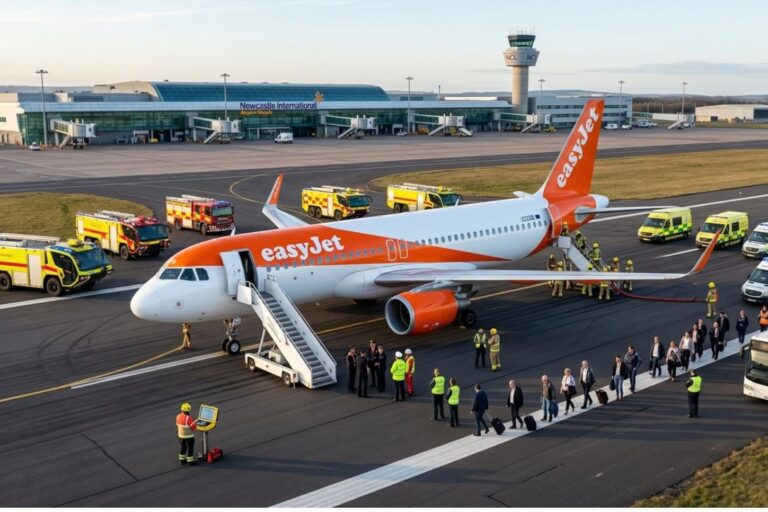
Commercial aviation relies heavily on strict safety standards and rapid decision making. When mid-air issues arise, flight crews and air traffic control work together smoothly. They always guarantee passenger safety above all else. A clear example occurred when EasyJet Flight U2238 Emergency Landing Newcastle became a major focus of aviation updates.
Understanding why flights make unscheduled landings offers valuable insight into modern airline protocols. Therefore, studying these events helps travelers understand flight safety measures and ground operations. This comprehensive breakdown examines the specific details, standard flight protocols, and operational procedures behind this notable diversion.
Detailed Breakdown of the Flight Incident
Aviation journeys require constant monitoring from departure until final arrival. During its scheduled service, the aircrew operating under the flight designation U2238 encountered a situation. This issue required an immediate change in the planned flight path. Consequently, the flight commander made a deliberate decision to head toward Newcastle International Airport.
Unscheduled diversions occur for a limited number of technical and medical reasons. However, airlines maintain firm guidelines that specify exact diversion procedures. Therefore, pilots land at the nearest suitable airport rather than continuing to their original destination.
Primary Causes for Unexpected Flight Diversions
A flight crew chooses to divert for several critical reasons:
- Medical Emergencies: A passenger or crew member experiences a sudden health issue. Therefore, the flight requires immediate ground hospital care.
- System Indications: Automated sensors report a technical anomaly in the cockpit. As a result, hydraulic pressure warnings prompt immediate precautionary measures.
- Severe Weather Patterns: Unexpected severe turbulence or freezing conditions affect safety. Thus, pilots alter their route to avoid dangerous airspace.
- Cabin Pressurization Issues: Altitude adjustments require a controlled descent to safer air levels. Consequently, crews choose a fast landing route.
Technical Hydraulic Systems in Modern Aircraft
Hydraulic systems power essential flight control surfaces and landing gear mechanisms. However, dual and triple redundancy systems protect modern twin-engine jet aircraft. Consequently, a loss of pressure in one system does not mean complete control failure.
Pilots monitor these hydraulic gauges continuously during all phases of flight. Therefore, when warning lights illuminate on the instrument panel, the crew responds immediately. They execute checklists designed by the aircraft manufacturer to manage pressure loss safely.
The Role of Hydraulic Fluid Redundancy
Modern commercial jetliners utilize isolated hydraulic fluid reservoirs for maximum safety. In addition, secondary electric pumps instantly activate if primary engine-driven pumps fail. Thus, key flight control surfaces remain fully responsive under all operational conditions.
Furthermore, backup mechanical systems provide additional control capabilities during extreme emergencies. Therefore, flight crews maintain positive control of the aircraft throughout the descent. Safety systems operate smoothly to guarantee a safe touchdown on the runway.
Air Traffic Control and Pilot Coordination
When an airborne situation arises, pilots follow a strict priority framework. Aviation professionals define this key process as Aviate, Navigate, and Communicate. Therefore, crew members complete these crucial actions in exact sequence to maintain safety.
First, pilots maintain complete control of the aircraft pitch, speed, and altitude. Next, they evaluate their exact position, remaining fuel, and nearby landing fields. Finally, they contact ground controllers to explain their exact operational needs.
Operational Sequence of a Flight Emergency
During an operational diversion, the flight transitions through five distinct standard phases:
- Standard Flight Route Phase: The aircraft maintains its normal cruise altitude along the planned flight path while systems run normally.
- System Warning Alert Phase: Cockpit sensors detect a technical anomaly or the crew identifies a severe medical situation requiring rapid ground attention.
- Transponder Squawk 7700 Activation: The pilot sets the transponder to code 7700, sending an instant high-priority emergency signal directly to air traffic control radar screens.
- Altitude Descent Initiation Phase: Air traffic controllers clear all nearby airspace and assign a direct, unobstructed descent path to the chosen airfield.
- Newcastle Priority Touchdown Phase: The aircraft completes a safe landing on the runway while airport fire and medical crews wait in position to assist.
Understanding Transponder Code Squawk 7700
Transponders send real-time tracking data to radar screens on the ground. Therefore, setting code 7700 alerts controllers that an aircraft requires priority handling. As a result, the aircraft target tag flashes brightly on ground control displays.
- Immediate Radar Highlighting: The aircraft target tag flashes on air traffic control displays clearly. Consequently, ground controllers identify the flight without delay.
- Airspace Clearance Priority: Surrounding traffic must adjust course or enter holding patterns quickly. Therefore, controllers clear all regional airspace for the incoming jet.
- Direct Landing Approach: Controllers clear the diverted aircraft for a straight path to the runway. As a result, pilots bypass standard busy holding patterns completely.
- Ground Response Activation: Fire trucks, medical crews, and mobile support teams assemble along the runway. Thus, rescue vehicles wait ready before touchdown occurs.
Strategic Importance of Newcastle International Airport
Newcastle International Airport serves as a major primary emergency airfield in northern England. Furthermore, its advanced infrastructure makes it ideally suited for unscheduled passenger landings. Therefore, diverted flights frequently select this facility during regional mid-air incidents.
| Airport Feature | Technical Specifications and Capability |
| Runway Length | Over 2,300 meters, capable of accommodating modern commercial aircraft. |
| Emergency Readiness | High-level Category On-Site Fire and Rescue Response teams. |
| Approach Systems | Precision Instrument Landing Systems (ILS) supporting safe low-visibility landings. |
| Ground Logistics | Direct terminal access, ground transport links, and rapid medical assistance. |
When an aircraft announces an unscheduled arrival, airport ground teams transition instantly to high alert. In addition, emergency vehicles take strategic positions along parallel taxiways. Consequently, ground personnel observe the landing closely and offer assistance if needed.
Runway Capabilities and Lighting Systems
Long runways allow heavy aircraft to land safely even with reduced braking efficiency. Furthermore, high-intensity runway lighting systems guide pilots down through heavy fog or night conditions. Therefore, Newcastle handles incoming diverted flights under challenging weather scenarios easily.
Modern runway surfaces feature specialized rubber-grooved asphalt to improve braking traction. As a result, stopping distances decrease significantly during wet weather operations. Thus, pilots bring the aircraft to a safe complete stop efficiently.
Ground Support Infrastructure and Services
Ground crews at Newcastle Airport receive specialized training for emergency arrivals. For example, mobile staircases and passenger buses move into position within minutes of landing. Therefore, passengers disembark from the aircraft without unnecessary delays or discomfort.
In addition, fuel trucks and maintenance engineers stand ready on the tarmac. Consequently, technical teams inspect the aircraft thoroughly right after engine shutdown. They work rapidly to determine the exact cause of any mechanical issue.
Comprehensive Passenger Care Protocols
An unexpected landing creates stress for travelers on board. Fortunately, modern commercial airlines use clear customer support strategies during operational disruptions. Therefore, passenger safety and comfort remain high priorities throughout the event.
In-Flight Crew Communication Techniques
Flight attendants complete rigorous training to maintain a calm environment inside the cabin. Furthermore, regular updates from the flight deck explain the situation clearly to everyone. Consequently, open communication prevents unnecessary panic among passengers during the descent.
Attendants double-check all safety belts and secure loose equipment in the galleys quickly. In addition, they review emergency exit procedures calmly with passengers sitting near exit rows. Therefore, the entire cabin remains orderly and fully prepared for touchdown.
On-Ground Medical and Technical Teams
If a medical situation prompted the landing, paramedics board the plane instantly upon arrival. Consequently, sick passengers receive professional medical care without losing vital minutes. However, if technical reasons caused the landing, engineers inspect the jet first.
Ground staff escort passengers smoothly into the terminal building after inspection. In addition, terminal services provide complimentary refreshments and access to communication networks. Therefore, travelers remain comfortable while waiting for updated flight schedules.
Onward Travel Coordination and Logistics
After disembarking safely, passengers receive immediate assistance from airline ground personnel. For example, airlines organize replacement aircraft when mechanical repairs require extended time. Furthermore, charter buses transport travelers directly to their final destinations when distances permit.
If overnight stays become necessary, airlines secure local hotel rooms and meals for everyone. Therefore, passengers suffer minimal inconvenience despite the major schedule change. Smooth logistics turn a stressful disruption into an organized travel solution.
Flight Safety Protocols in European Commercial Aviation
Low-cost carriers operate under strict regulations enforced by top aviation authorities. For instance, the Civil Aviation Authority monitors all flight operations within the United Kingdom. In addition, safety agencies enforce continuous aircraft maintenance schedules strictly.
The Aviation Safety Escalation Framework
Aviation safety operates across three distinct organizational tiers:
- Level 1 – Regulatory Oversight: The Civil Aviation Authority (CAA) and European aviation bodies establish strict airworthiness standards, flight hour rules, and mandatory operating policies.
- Level 2 – Airline Maintenance Programs: Licensed engineers execute rigorous daily inspections, mandatory component replacements, and structural system checks on every operational fleet aircraft.
- Level 3 – Flight Crew Execution: Highly trained pilots and cabin crews carry out precautionary diversions and standard operating procedures calmly whenever anomalies occur in flight.
Precautionary diversions demonstrate safety systems working exactly as designed by engineers. Furthermore, commercial aviation always favors addressing minor issues early. Therefore, diverting a flight remains a proactive safety decision rather than a failure.
Pilot Training and Simulator Exercises
Pilots undergo mandatory simulator testing twice every year to maintain their flight licenses. During these simulator sessions, instructors test pilots on complex hydraulic failures and emergency landings. Therefore, real-world unexpected diversions feel completely familiar to experienced flight crews.
Simulator training recreates difficult weather conditions, system alerts, and short runways accurately. As a result, pilots react instinctively and correctly when real cockpit alarms sound. Consequently, flight crews handle unexpected situations smoothly without hesitation.
Mandatory Aircraft Maintenance Checks
Airlines conduct routine maintenance checks after specified numbers of flight hours. For example, routine checks inspect hydraulic lines, electrical wiring, and flight control linkages. Therefore, mechanics discover minor wear before it causes operational problems in the air.
Major maintenance overhauls dismantle the aircraft periodically to examine structural components deeply. In addition, engineers replace worn components proactively before their expected lifespan ends. Thus, commercial aircraft maintain outstanding safety records globally.
Detailed Chronology of Emergency Response Procedures
Understanding the exact timeline of an unscheduled landing reveals incredible professional coordination. Air traffic controllers, pilots, and ground teams execute synchronized steps within seconds. Therefore, every action increases aircraft safety during the landing phase.
Initial Alert and Cockpit Assessment
Cockpit warning systems alert the flight crew to system anomalies immediately. Next, the captain takes manual control of the flight instruments while the first officer opens emergency manuals. Together, they confirm the nature of the warning and evaluate local airport options.
After identifying Newcastle as the best option, the first officer contacts air traffic control. The pilot states the flight callsign clearly and requests immediate priority clearance. Consequently, controllers clear surrounding airspace instantly to create an open descent path.
Radar Tracking and Descent Management
Air traffic controllers assign a dedicated radar channel to the diverted aircraft. Furthermore, ground operators clear lower altitude levels to facilitate a steady, controlled descent. Thus, the aircraft leaves its high cruise altitude smoothly without facing traffic obstacles.
Controllers communicate wind speeds, weather conditions, and runway conditions to the pilots continuously. Meanwhile, airport fire services take positions along the designated landing strip. Ground crews standby with foam equipment and emergency gear ready for immediate use.
Approach, Touchdown, and Post-Landing Operations
The flight crew aligns the aircraft with the runway centerline miles before arrival. In addition, the pilots select appropriate flap settings to guarantee a stable touchdown speed. Consequently, the aircraft touches down smoothly on the pavement at Newcastle Airport.
The post-touchdown process follows a structured path to ensure complete passenger safety:
- Step 1: The aircraft completes its touchdown on the designated runway, deploying reverse thrust and brakes safely.
- Step 2: Specialized airport rescue and firefighting vehicles escort the aircraft as it taxis off the main runway.
- Step 3: The flight reaches a designated airport gate under full ground service supervision.
- Step 4: Passengers disembark orderly into the terminal building while technical crews evaluate the hydraulic system.
Emergency vehicles escort the landing aircraft as it taxis slowly toward the gate. Ground personnel inspect the landing gear tires and brake temperatures using thermal sensors. Finally, passengers disembark safely into the terminal while maintenance teams inspect the hydraulic system.
Impact of Diversions on Commercial Flight Operations
Flight diversions impact airline flight schedules across whole regional transport networks. Therefore, operations centers work continuously to minimize cascading flight delays for other passengers. Efficient planning reduces secondary disruptions across the network significantly.
Aircraft Fleet and Crew Rescheduling
When a plane lands at an unscheduled airport, airline dispatchers adjust flight schedules instantly. For example, dispatchers assign backup aircraft from nearby hubs to cover remaining flight legs. Consequently, downstream passenger delays remain as short as possible.
Flight crew duty limits also dictate operational decisions after unexpected diversions occur. Flight crews cannot exceed maximum legal duty hours set by international aviation laws. Therefore, airlines dispatch fresh crew members quickly to take over flight duties.
Environmental and Financial Considerations
Precautionary landings involve operational costs including emergency fees, extra fuel, and passenger care. However, airlines prioritize safety over financial considerations during every flight situation. Thus, flight commanders divert without facing internal corporate pressures.
Fuel jettison or burning off excess fuel sometimes occurs before landing on shorter runways. Reducing total landing weight protects the aircraft structure and braking systems during touchdown. Therefore, pilots calculate landing weights carefully before starting their final approach.
Key Takeaways from Unexpected Air Landings
Events like the EasyJet Flight U2238 Emergency Landing Newcastle prove the strength of modern flight safety networks. Key takeaways include:
- Safety Always Takes Precedence: Diverting a flight remains a standard procedure to keep passengers safe, even for minor issues.
- Well-Rehearsed Procedures: Pilots and air traffic controllers practice diversion scenarios continuously in advanced flight simulators.
- Robust Regional Infrastructure: Airports like Newcastle maintain complete readiness to support incoming diverted aircraft smoothly.
- Strict Post-Incident Inspections: Maintenance teams inspect every diverted aircraft thoroughly before clearing it to return to normal passenger service.

1 Comment
Pingback: Cindy Yu: The Times, Age, Husband, and Spectator Career Update