



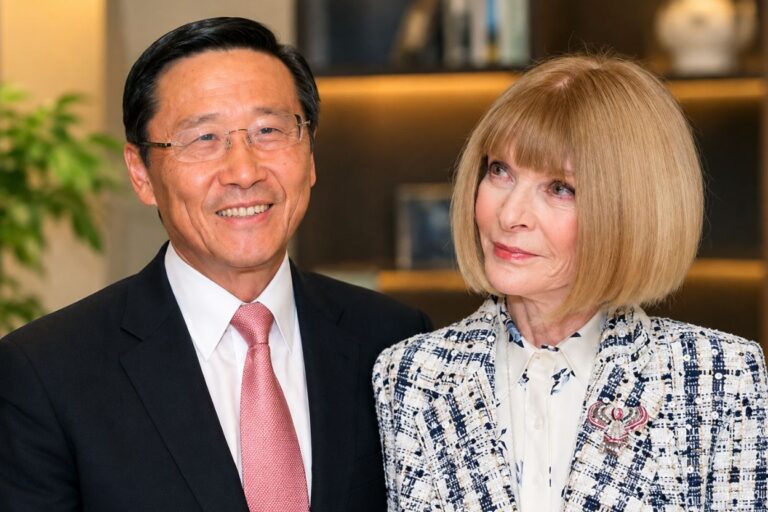
Peter Woo and Anna Wintour have developed influential careers in different parts of the international business world. Woo built his reputation through investment, property development, corporate leadership, and luxury retail. Wintour became a major figure in fashion publishing through her work with Vogue and Condé Nast. Their professional backgrounds offer useful insights into wealth, leadership, fashion, and international business.
The relationship between these two figures needs a clear explanation. Woo has connections to businesses that develop commercial spaces and sell luxury products. Meanwhile, Wintour has influenced how fashion reaches audiences through magazines, designer coverage, celebrity culture, and major industry events. Both operate in sectors where reputation and consumer interest can affect commercial success.
However, their shared connection to the luxury industry does not establish a personal or professional partnership. Available biographical information does not confirm that they are relatives, romantic partners, or direct business associates. Therefore, their careers are best understood separately before considering their wider industry connections.
This article explores their backgrounds, achievements, business interests, financial influence, and public profiles. It also explains Peter Woo and Anna Wintour respective positions as of October 2026 without treating speculation as established fact.
Who Is Peter Woo?
Peter Woo Kwong-ching is a Hong Kong businessman known for his extensive involvement in property, investment, retail, and corporate leadership. Born in Shanghai, he received his early education in Hong Kong before pursuing higher education in the United States. His academic training helped prepare him for a career involving finance, strategic decisions, and business management.
Woo studied physics and mathematics at the University of Cincinnati. He later earned a Master of Business Administration from Columbia Business School. These qualifications gave him an academic foundation for understanding complex problems and managing commercial organisations.
His professional journey began in New York, where he worked for Chase Manhattan Bank during the early 1970s. This experience introduced him to international finance and corporate banking. In 1975, he joined his future wife’s family business in Hong Kong, beginning a new stage in his career.
Over time, Woo became a leading figure at Wheelock and Company and The Wharf (Holdings) Limited. These companies maintained interests in property and several other commercial sectors. His responsibilities eventually extended beyond traditional real estate into retail, telecommunications, ports, and investment.
Peter Woo’s Early Life and Education
Woo’s early life connected him with both Hong Kong and mainland China. His subsequent education in the United States broadened his experience and exposed him to different academic and business environments. This international background became valuable as his responsibilities expanded.
Studying physics and mathematics requires logical reasoning and careful analysis. Although these subjects differ from business management, they can help develop skills useful for assessing complicated decisions. His later MBA studies added formal training in finance, strategy, and organisational leadership.
Woo’s first professional role also provided valuable practical experience. Banking required an understanding of companies, financial risks, and the movement of capital. Furthermore, working in New York exposed him to an international business environment before he returned to Hong Kong.
His career illustrates how education and professional experience can support a move into corporate leadership. Nevertheless, his later achievements also depended on business opportunities, relationships, management decisions, and changing economic conditions.
His Entry Into Hong Kong Business
Joining the business associated with shipping entrepreneur Y. K. Pao connected Woo with an established commercial enterprise. Shipping played an important role in Hong Kong’s development as a centre for international trade. The sector also offered connections to finance, logistics, investment, and property.
Woo eventually moved beyond the original business environment into a wider range of industries. His leadership at Wheelock and Wharf placed him closer to major property investments and other commercial assets.
This transition was important because Hong Kong’s economy offered opportunities across several connected sectors. Commercial buildings supported businesses, ports facilitated trade, and retail operations served local and international customers.
Consequently, Woo’s career developed around a broad business structure rather than a single product or service. His experience also demonstrates the importance of understanding how different industries interact within an international economy.
Peter Woo’s Business Interests and Wealth
Property Development and Commercial Assets
Property has been one of the most important parts of Woo’s business career. Wheelock and Wharf became associated with substantial commercial and residential property interests. These assets can generate income through leasing, property sales, development projects, and related services.
Commercial real estate also influences the surrounding economy. Office buildings provide space for companies, shopping centres attract customers, and residential developments support communities. Therefore, major property groups can affect employment, retail activity, and urban development.
However, property investment involves significant risks. Interest rates can influence borrowing costs, while economic changes can affect demand for homes and commercial space. Vacancies, maintenance expenses, and regulatory requirements can also influence profitability.
Woo’s business history demonstrates the importance of long-term asset management. Successful property operations require financial planning, careful investment decisions, and an understanding of local market conditions. These responsibilities become especially complex when a company owns assets across several locations and sectors.
Luxury Retail and Lane Crawford
Woo’s business interests have also included the Lane Crawford Joyce Group, associated with luxury fashion and premium retail in Greater China and other Asian markets. This part of his commercial background provides a natural connection to the wider fashion industry.
Luxury retailers help connect designers with customers. They select collections, manage inventory, maintain stores, and develop relationships with international brands. Moreover, they must understand changing customer expectations and the cultural value associated with particular products.
A successful luxury retailer does more than sell expensive clothing. It creates an environment where customers can discover brands, compare collections, and receive specialised service. Store presentation, product selection, location, and customer experience all contribute to its identity.
Digital commerce has also changed the industry. Customers can now discover designers through social media and purchase products through online platforms. As a result, traditional retailers must combine physical shopping experiences with convenient digital services.
Woo’s retail interests show how luxury fashion connects with property, branding, consumer behaviour, and international trade.
Peter Woo’s Net Worth in 2026
Peter Woo is widely recognised as a billionaire whose fortune comes largely from real estate and investments. Forbes has published a real-time net worth estimate of approximately $14 billion in late October 2026. However, this figure represents a changing estimate rather than a fixed amount of cash.
A billionaire’s reported wealth can include shares, private company holdings, property interests, and other investments. Consequently, the estimated value can rise or fall as financial markets and asset valuations change.
Woo’s business interests also demonstrate why wealth estimates require careful interpretation. The value of a property portfolio depends on market conditions, rental income, debt, and future development opportunities. Similarly, private investments may be difficult to value precisely.
Therefore, his estimated fortune offers an indication of his financial position, but it does not reveal every detail of his assets or personal spending. His long-term influence comes from his business history as well as the value associated with his investments.
Who Is Anna Wintour?
Anna Wintour is a British-American fashion journalist and media executive who has influenced fashion publishing for decades. Born in London on November 3, 1949, she grew up in a family connected to journalism. Her father, Charles Wintour, worked as a newspaper editor, giving her early exposure to the media industry.
Wintour entered fashion journalism during the early 1970s. She gained experience through editorial positions before moving into senior roles in the United States. Her career eventually led her to American Vogue, where she became editor-in-chief in 1988.
During her leadership, Vogue developed a distinctive editorial identity. The magazine combined designer fashion with celebrity culture, striking photography, and broader cultural stories. Its coverage helped introduce designers and fashion trends to readers around the world.
Wintour also expanded her influence beyond one publication. Her responsibilities at Condé Nast connected her with a wider portfolio of media brands. In addition, she became closely associated with major fashion events, especially the Metropolitan Museum of Art’s Costume Institute benefit gala.
In 2025, Wintour stepped away from the daily editorial leadership of American Vogue. Chloe Malle became its head of editorial content in September 2025. Nevertheless, Wintour retained her positions as Condé Nast’s chief content officer and global editorial director of Vogue in 2026.
Anna Wintour’s Early Career
Wintour developed her editorial skills during a period when fashion magazines played a central role in the industry. Readers relied on print publications to discover designers, understand trends, and see collections presented through professional photography.
Her early experience helped her understand how editorial decisions influence the presentation of fashion. Editors choose stories, direct creative projects, and decide which ideas deserve attention. These decisions require a balance between artistic judgement, audience interests, and commercial priorities.
Wintour later worked in the United States, where she gained experience with the country’s fashion media landscape. The American market offered opportunities to combine fashion with celebrity culture and broader lifestyle coverage.
Her appointment to lead American Vogue in 1988 marked a major turning point. She developed an approach that made fashion publishing more connected to popular culture while maintaining its focus on designers and luxury.
How Anna Wintour Influenced Vogue
Wintour helped strengthen the connection between fashion and celebrity culture. Magazine covers increasingly featured actors, musicians, and other public figures alongside models and designers. This approach introduced fashion to audiences who might not otherwise follow the industry closely.
She also helped bring attention to designers and creative talent. Editorial exposure can influence brand recognition, attract potential customers, and introduce new names to retailers. However, a magazine feature alone cannot guarantee commercial success.
Another important part of Vogue’s development involved its visual presentation. Fashion photography became a way to tell stories about identity, art, culture, and personal style. Clothing appeared within wider narratives rather than as a simple list of products.
Furthermore, Wintour worked during the transition from print publishing to digital media. Online articles, video content, and social platforms changed how audiences consumed fashion information. Her wider role at Condé Nast placed her within this changing media environment.
Peter Woo and Anna Wintour: What Connects Them?
Their Shared Connection to Luxury
The strongest comparison between Peter Woo and Anna Wintour concerns the wider luxury industry. Woo’s business interests include premium retail, while Wintour’s career centres on fashion media and cultural influence. These activities can support the same industry without requiring a direct partnership.
Luxury fashion depends on several connected groups. Designers create collections, retailers bring products to customers, and media organisations introduce brands to wider audiences. Consumers then decide which products and designers deserve Peter Woo and Anna Wintour attention.
Retailers benefit when customers recognise a brand and understand its identity. Meanwhile, fashion publications benefit from access to designers, collections, and industry developments. This relationship creates opportunities for cooperation across the wider market.
Nevertheless, retail and editorial work have different goals. A retailer must manage inventory, customer service, pricing, and profitability. An editor focuses on stories, creative direction, cultural relevance, and the publication’s identity.
Therefore, Peter Woo and Anna Wintour professional backgrounds offer a useful comparison of different forms of influence. One involves business ownership and commercial assets, while the other involves media leadership and public attention.
Are Peter Woo and Anna Wintour Business Partners?
Available reliable public information does not establish a direct business partnership between Woo and Wintour. Their careers intersect through the broader luxury environment, but this does not prove that they jointly managed a company or project.
A confirmed partnership would require specific evidence. For example, a company announcement, a documented joint venture, or credible reporting could establish a professional relationship. Without such evidence, describing them as direct business partners would be misleading.
Their industries can interact even when their leaders have no documented personal connection. Fashion editors cover designers whose products appear in luxury stores, while retailers respond to trends discussed in the media.
However, general industry overlap should not be confused with direct cooperation. A careful account must distinguish between established facts and possible connections that lack supporting documentation.
Are They Related or Personally Connected?
There is no reliable public evidence establishing that Peter Woo and Anna Wintour are relatives or romantic partners. Peter Woo and Anna Wintour documented biographies focus on different careers and professional environments.
Woo’s personal history includes his marriage to Bessie Pao, the daughter of shipping entrepreneur Y. K. Pao. Their family background is closely connected to Hong Kong business history.
Wintour’s personal life has included her marriages to David Shaffer and, later, Shelby Bryan. Her family and career have received extensive media attention because of her public role in fashion.
These separate biographies do not establish a personal relationship between Woo and Wintour. It is therefore important not to infer family ties or romantic involvement from their professional prominence.
Comparing Their Leadership Styles and Influence
Business Leadership Versus Editorial Leadership
Woo’s career reflects the responsibilities of a business leader managing investments and corporate assets. Such work involves evaluating risks, allocating capital, planning long-term growth, and overseeing complex operations.
Wintour’s leadership developed through editorial judgement and creative decision-making. Her work requires an understanding of fashion, audience interests, visual storytelling, and the changing priorities of a global media company.
Although these responsibilities differ, both careers involve making decisions that affect other people. A major investment can influence employees, suppliers, tenants, and customers. An editorial decision can affect a designer’s visibility, a publication’s identity, and the audience’s understanding of fashion.
Neither form of influence operates in isolation. Business leaders respond to markets and economic conditions, while editors respond to cultural change and audience expectations. Both must adapt as their industries evolve.
Their International Reach
Woo’s career connected Hong Kong business with international finance, property investment, retail, and trade. His education and early banking experience also gave him exposure to business environments outside Hong Kong.
Wintour’s career connected British journalism with American fashion publishing and global media leadership. Vogue operates across numerous countries, with editorial teams that reflect local audiences and cultural interests.
International reach can create opportunities, but it also introduces challenges. Businesses must understand different regulations, customer habits, and economic conditions. Media organisations must consider cultural differences while maintaining consistent editorial standards.
Their experiences show how international influence can develop through different routes. Woo built his reputation through corporate and investment activity, while Wintour developed hers through fashion journalism and media management.
Anna Wintour’s Role in Fashion Events and Culture
The Met Gala
The Met Gala is one of the most prominent annual events in the fashion calendar. It raises funds for the Metropolitan Museum of Art’s Costume Institute and brings together designers, celebrities, artists, and other influential figures.
Wintour has played a central role in the event’s development. Under her leadership, it gained a wider public profile and became known for its distinctive fashion themes and high-profile guests.
The gala also demonstrates how fashion can connect with art and history. Clothing choices often reflect a theme, a designer’s creative approach, or a wider cultural idea. Consequently, the event generates discussion beyond the fashion industry itself.
Its commercial influence can be significant, although the results vary. Public attention may increase interest in brands and designers, but visibility does not automatically translate into sales. The event’s main institutional purpose remains fundraising for the Costume Institute.
Supporting Emerging Designers
Wintour’s work has also involved initiatives that support new fashion talent. The CFDA/Vogue Fashion Fund, for example, has helped developing designers through financial support, mentorship, and industry exposure.
Emerging brands often face challenges when entering a competitive market. They must fund production, attract customers, build reliable supply chains, and communicate their creative identity. Industry recognition can help them establish relationships with retailers and other professionals.
Editorial coverage may also introduce a designer to an international audience. However, sustained success requires more than attention. Designers need products that meet customer expectations, sound financial planning, and the ability to respond to changing trends.
These initiatives illustrate how media influence can contribute to the wider fashion ecosystem without making an editor the owner of the brands receiving support.
Peter Woo’s Legacy in Hong Kong
Corporate and Public Leadership
Woo’s influence extends beyond his commercial holdings. He chaired the Hong Kong Trade Development Council from 2000 to 2007. He also served as chairman of the Hospital Authority from 1995 to 2000.
These positions involved responsibilities connected to trade promotion and public healthcare administration. They show that his public profile has included institutional leadership as well as private business activity.
His career also reflects Hong Kong’s role as an international business centre. The city connects regional markets with global finance, logistics, retail, and professional services. Leaders working in these sectors often operate within complex international networks.
However, evaluating a business leader’s legacy requires more than looking at wealth. It also involves examining corporate decisions, institutional responsibilities, economic conditions, and the long-term effects of business activity.
Family Business and Succession
Family ownership has played a role in Woo’s business history. His son Douglas later became chairman of Wheelock, reflecting a transition in leadership responsibilities.
Succession planning matters because large companies must maintain stability while preparing for future challenges. New leaders need to understand existing assets, assess risks, and decide where investment should go next.
A change in leadership can also create opportunities for different strategies. Companies may adjust their operations, reconsider development plans, or respond to changes in consumer behaviour.
Woo’s experience illustrates how major business groups can continue through changes in leadership. Nevertheless, each transition requires its own decisions and should not be treated as a guarantee of future performance.
What Their Careers Reveal About Wealth and Influence
Peter Woo and Anna Wintour demonstrate that influence can develop through very different professional paths. Woo’s career centres on investment, property, corporate ownership, and commercial management. Wintour’s influence comes from editorial decisions, fashion publishing, and media leadership.
Their experiences also reveal the relationship between money and public attention. Financial resources can support business expansion, while media coverage can help shape consumer awareness. However, neither wealth nor visibility guarantees lasting success.
Both sectors face ongoing change. Property companies must respond to economic conditions, borrowing costs, and demand. Luxury retailers must adjust to digital shopping and shifting customer preferences. Fashion publishers must develop new ways to reach readers while maintaining editorial quality.
These challenges require long-term planning and an understanding of changing markets. Consequently, their careers offer different examples of how established leaders respond to competition and evolving expectations.
Peter Woo and Anna Wintour in 2026
As of October 2026, Woo remains known for his historical leadership of major Hong Kong business groups and his investment interests. His son Douglas leads Wheelock, while Woo’s broader business legacy continues to attract attention because of its scale and diversity.
Wintour continues to hold senior positions at Condé Nast. Chloe Malle leads the daily editorial direction of American Vogue, while Wintour retains global responsibilities across Vogue and the wider media group.
These developments demonstrate that leadership can evolve without removing a person’s influence. Woo’s career shows how ownership and corporate succession shape business history. Wintour’s current roles illustrate a shift from direct editorial management toward broader strategic leadership.
Their positions should be understood through documented responsibilities rather than assumptions about their private lives. No confirmed direct partnership between them has been established by the reliable biographical information reviewed.
Conclusion
Peter Woo and Anna Wintour have influenced different parts of the international luxury economy. Woo built a business career through property, investment, retail, and corporate leadership. Wintour shaped fashion publishing through Vogue, designer coverage, and major cultural events.
Their professional worlds can intersect through luxury brands and consumer culture. However, this shared industry does not establish that they are relatives, romantic partners, or direct business associates.
Understanding their careers separately provides a more accurate picture of their achievements. Woo’s legacy centres on business development and investment, while Wintour’s influence centres on editorial leadership and fashion culture.
Together, their stories demonstrate that international influence takes many forms. One can shape markets through ownership and capital, while another can influence public taste through media and creative direction.
