

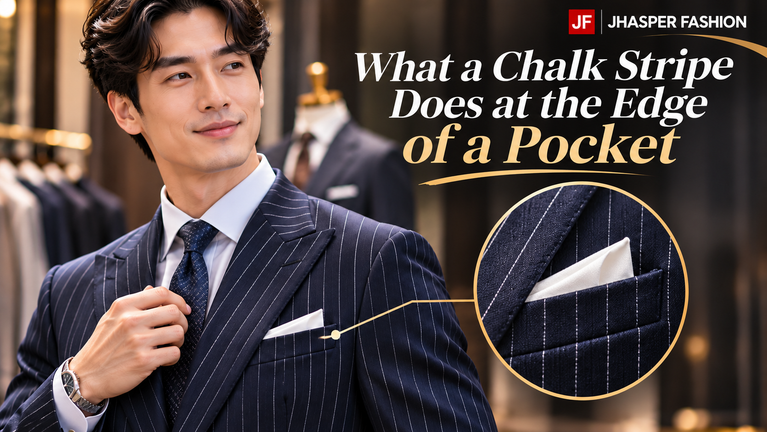
Pick a pale line on a dark chalk-stripe jacket and follow it down with your eye. For several inches the going is easy. Then the line reaches a pocket and has a decision to make. It may carry on so quietly that the pocket nearly vanishes. It may stop beneath a flap. On an angled opening it can seem to take a small step sideways. Much of the character of a striped jacket lives in that inch of cloth.
Start with a patch pocket. A separate piece of cloth sits on top of the jacket front, so you can see the stripes on two layers at once. Where the pale lines line up, the patch seems pressed into the surface. Find the edge with your finger and step back again. Sometimes a row of stitching or a slight shadow is the only thing giving the game away.
Watch the outline as well as the stripe
A patch also has a rounded corner. Even when the straight lines agree across its center, the outline will cross them as it curves. That crossing is part of the drawing. Expecting every stripe to follow the rounded edge is rather like expecting the lines on a sheet of graph paper to turn with a coffee cup placed on top of it.
Now look at a slanted flap. Its lower edge cuts across vertical lines at an angle, making the ends of the stripes form a little staircase. The effect can be lively on a widely spaced stripe and almost invisible on a narrow one. Jhasper Fashion’s jacket designs show straight flaps, slanted flaps, and patch pockets. Use the shapes as a reference, then lay a paper cutout of each over the same striped swatch. You can see the rhythm change before a tailor cuts a pocket.
Try the cutout again, this time shifting it sideways by half the distance between two stripes. Trace a short piece of each line onto the paper before you move it. What looked like a long stroke now breaks into two blunt ends. The width and angle of the pocket have stayed the same. That small experiment isolates the part of the effect that comes from where the cutter places the pattern on the cloth.
Take two steps back
Wear the jacket when you judge the result. An empty pocket lies close to the body. A slim card case can lift one edge and shift the apparent alignment. So can a hand in the pocket or a jacket hanging crookedly from one shoulder. Empty it, settle the jacket, and look straight on. A stripe that still jumps in a prominent place is worth discussing, especially if the intention was an uninterrupted front.
Ask to see both sides in the same light. A shadow under one flap can make identical spacing look uneven in a close crop of a photograph.
Then take in the whole garment from across a room. You may find that a nearly invisible pocket leaves a busy stripe pleasantly calm. Or you may prefer the assertive slash of a slanted flap against all that disciplined vertical cloth. Either is a judgment you can describe precisely. Follow one chalk line to its first interruption and you can tell a tailor where you want the eye to pause.
