


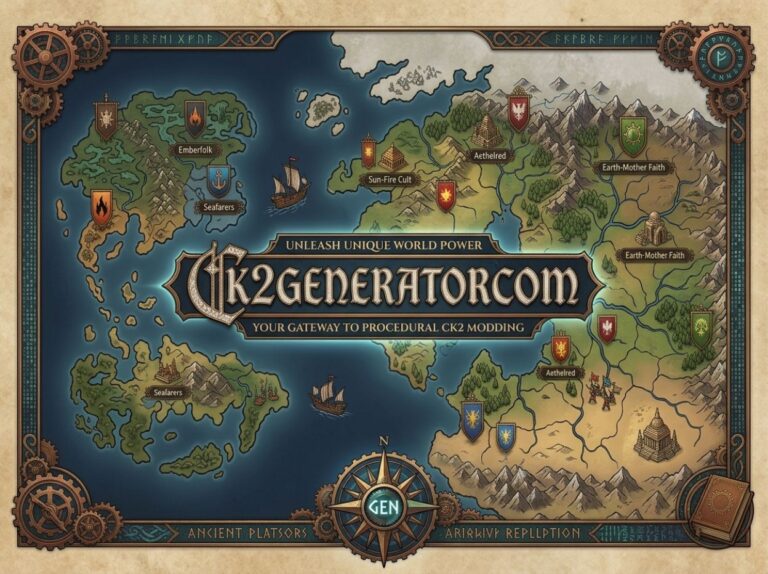
ck2generatorcom stands out as a powerful resource for grand strategy fans who want fresh experiences. Crusader Kings II offers exceptional strategic depth, but playing on the standard map can feel predictable over time. Players often memorize every mountain pass, kingdom border, and historical ruler position. As a result, many gamers look for new ways to overhaul their favorite strategy title.
Through procedural generation, custom map design, and deep historical simulation, ck2generatorcom delivers total procedural freedom. This comprehensive guide explores how ck2generatorcom operates, how to configure generated settings, and how to troubleshoot technical issues easily.
What Is CK2Generatorcom and How Does World Generation Work?
The foundation of ck2generatorcom relies on procedural world generation algorithms. Instead of loading static historical files from the base game, advanced algorithms build custom geography and synthetic historical timelines from scratch.
Understanding the Map Generation Pipeline
First, the system designs a brand-new physical heightmap. Consequently, this heightmap establishes landmass shapes, ocean depths, mountain ranges, and coastal plains. Next, climate models project rainfall patterns and global temperature shifts across every province. Therefore, biomes like frozen tundras, dense jungles, arid deserts, and temperate grasslands appear logically.
Simulating History and Noble Lineages
After geography settles, civilizational generation begins automatically. The engine outlines province borders based on natural rivers and steep ridges. Furthermore, it simulates centuries of virtual history before your starting game date. Synthetic cultures migrate across continents, while dynamic religions split into custom heresies. Finally, noble bloodlines claim title rights over newly formed kingdoms. The application packages everything into a functional mod directory.
Exploring Core Features on CK2Generatorcom
The features available through ck2generatorcom extend far beyond simple landmass generation. Players retain complete control over almost every environmental variable, cultural mechanic, and religious system.
Customizing Map Topography and Climate Options
You can adjust sliding parameters to control how your world forms:
- Land Mass Ratios: Choose between massive single continents, scattered island chains, or balanced multi-continent worlds.
- Tectonic Ruggedness: Increase mountain density to form defensible valleys or flatten terrain into vast open plains.
- Water Systems: Control river frequency and fjord density to influence trade routes and naval transport options.
- Biome Distributions: Enforce warmer global temperatures or build arctic worlds where winter penalties threaten army survival.
Dynamic Cultural Drift and Naming Conventions
Instead of using traditional historical cultures, dynamic algorithms combine phonetic roots to generate unique naming lists:
- Synthetic language engines form original family names, noble titles, and kingdom designations.
- Cultural traditions evolve according to geography, giving coastal groups naval bonuses while inland plains dwellers gain cavalry bonuses.
- Cultural divergence models simulate how distant provinces split away from an empire over time.
Deep Dive into Religion Mechanics on CK2Generatorcom
Religions form organically across generated continents with unique traits and customized spiritual laws.
Holy Sites and Sacred Locations
In standard historical games, holy sites remain fixed in predefined cities. However, procedurally generated worlds assign holy sites dynamically based on simulated historical events. Therefore, sacred temples appear in meaningful geographical hubs across your generated map.
Pantheon Structure and Religious Dogma
Furthermore, you can customize how spiritual beliefs operate in your realm:
- Monotheistic Faiths: Build centralized religions focused on single deities and rigid holy laws.
- Polytheistic Pantheons: Design open pantheons where regional gods grant varied bonuses to local rulers.
- Ancestor Worship: Create tribal traditions centered on honoring ancient rulers and family heritage.
Dynamic Religious Head Systems
Additionally, religious leadership structure alters diplomatic gameplay significantly:
- Spiritual Popes: Form independent religious leaders who control excommunication powers and launch holy crusades.
- Temporal Divine Kings: Combine political power and spiritual leadership into a single supreme ruler position.
- Council Elders: Establish decentralized religious bodies that manage faith stability without central authority figures.
Heresy Spawns and Authority Decay
When a faith suffers from low moral authority, alternative religious sects emerge rapidly. Consequently, local rulers must decide whether to suppress new heresies through force or adopt emerging beliefs for political advantage.
Step-by-Step Setup and Installation Guide
Setting up procedurally generated worlds requires systematic file management. Follow this structured process to install your custom worlds correctly.
Mod Installation Summary
| Step Number | Phase Name | Primary Action Required | Key Output or Directory |
| Step 1 | Software Setup | Run generator and adjust options | Configured settings |
| Step 2 | History Run | Simulate centuries of history | Completed world files |
| Step 3 | File Copying | Extract .mod file and folder | Generated output package |
| Step 4 | Directory Transfer | Move items to game mod folder | Documents/Paradox Interactive/Crusader Kings II/mod |
| Step 5 | Launcher Activation | Toggle mod on inside launcher | Active custom mod profile |
Checking System Prerequisites
Before launching the creation software, ensure your setup meets these essential criteria:
- Clean Installation: Maintain a stable game installation updated to its final official patch version.
- System Memory: Use at least 8 GB of RAM to handle deep history simulation smoothly.
- Storage Space: Allocate at least 2 GB of free solid-state drive space for temporary generation files.
Step 1: Generating World Files
Launch your procedural creation tool. Navigate through configuration menus to adjust terrain roughness, religion counts, and cultural variance levels. Once settings are locked, press the primary generation button. Allow background history simulations to complete without interrupting the software.
Step 2: Locating Output Directories
When world creation finishes, the engine packages content into an output folder. Locate these essential components inside your designated output directory:
- A descriptor file ending with
.mod - A matching content folder containing map graphics, province data, land titles, and character histories
Step 3: Placing Files into Mod Folders
Copy both the .mod descriptor file and its matching content folder into your local game user directory. For standard Windows installations, place files in this exact directory location:
C:\Users\[YourUsername]\Documents\Paradox Interactive\Crusader Kings II\mod\
Step 4: Activating Mods via Game Launcher
Open your primary game launcher. Navigate directly to the active mod selection interface. Next, locate your newly generated mod entry and enable its activation checkbox. Finally, verify that no conflicting total conversion mods run simultaneously before starting your game.
Balancing Empires on CK2Generatorcom
Creating an enjoyable campaign requires finding a fine balance between political chaos and empire stability. ck2generatorcom gives players precise control over starting political landscapes.
Political Setup Variations
| Setup Type | Starting Political Landscape | Gameplay Dynamics | Strategic Opportunities |
| Shattered Realm | Hundreds of independent counts | Intense early land rush | Rapid territorial expansion |
| Balanced Empires | Two or three large ancient empires | Cold-war diplomatic stalemates | Strategic alliances and intrigue |
Custom Dynasty Lineages and Sacred Artifacts
Furthermore, historical depth relies heavily on ancient heirlooms and legendary bloodlines. Advanced settings allow you to seed custom bloodlines across royal family trees. Rulers inheriting these lineages earn prestige bonuses, martial skill multipliers, or diplomatic boosts. Similarly, ancient weapons, crowns, and relics land randomly inside royal treasuries, giving ambitious kings long-term conquest goals.
Tactical Strategies for Procedurally Generated Worlds
Adapting your strategy to unfamiliar terrain is where procedural strategy gaming shines brightest. Standard historical tactics will not always work when physical geography changes completely.
Geographical Reconnaissance and Map Analysis
When loading into a new world, pause the clock and examine your surroundings carefully:
- Identify Strategic Chokepoints: Locate narrow mountain passes and river crossings. Building forts in these locations allows small forces to defend against larger invading armies.
- Locate Trade Arteries: Major rivers and ocean estuaries generate significant gold revenue. Prioritize conquering coastal territories near major trade channels to boost tax collection.
- Examine Defensive Biomes: Marshlands, mountains, and dense forests offer strong defensive combat bonuses. Position your primary capital inside naturally protected terrain.
Managing Religious Diplomacy and Holy Wars
In a procedurally generated setting, religious borders look completely different:
- Monitor Moral Authority: Newer religions often struggle with low moral authority initially. If your faith drops below thirty percent authority, dangerous heresies will spread quickly across your provinces.
- Capture Sacred Holy Sites: Direct military campaigns toward provinces containing your faith’s holy sites. Controlling these locations boosts authority while unlocking powerful holy orders.
- Assess Holy War Risks: Triggering a holy war against a neighboring ruler lets all nearby rulers of their faith join defensively. Therefore, always analyze surrounding religious maps before declaring war.
Troubleshooting Common Generated Mod Issues
Because custom generated mods rewrite base map files, players occasionally experience minor technical errors or crash events. Fortunately, resolving these issues requires simple troubleshooting steps.
Game Crashes During Map Loading Screens
If your game crashes while loading map graphics, try these steps:
- Clear Map Cache: Delete your local map cache folder inside
Documents\Paradox Interactive\Crusader Kings II\map\cache\. - Verify Screen Resolution: Ensure your custom map resolution matches standard aspect ratios supported by your game engine.
- Check DLC Compatibility: Confirm that visual options selected during generation do not require missing expansion packs.
Resolving Missing Map Textures and Black Terrain
If your generated world loads with pitch-black terrain textures or missing water graphics:
- Confirm that heightmap graphics exported cleanly without file corruption.
- Update your graphics card drivers to the latest stable driver release.
- Disable conflicting graphical overhaul mods inside your active launcher list.
Fixing In-Game Lag and Performance Slowdowns
As game campaigns progress over several in-game centuries, performance bottlenecks can occur if character populations grow too large:
- Restrict the total number of unlanded court characters generated per province during initial setup.
- Reduce the total count of barony holdings assigned per province in creation settings.
- Run console commands periodically to clean up extinct family trees and reduce saved file size.
Advanced Customization Techniques on CK2Generatorcom
Experienced players often want to push procedural generation further. Luckily, ck2generatorcom allows deep customization through manual config editing and parameter tweaking.
Modifying Generation Presets
You can edit configuration files directly before running world creation. For example, adjusting land distribution settings lets you control continent spacing precisely. Similarly, tweaking cultural variance sliders changes how quickly new languages split off from parent dialects.
Fine-Tuning Character Stat Distributions
Moreover, adjusting ruler generation parameters changes how competent starting lords appear across the globe:
- High Skill Variances: Creates a world filled with absolute geniuses and incompetent rulers side-by-side.
- Balanced Skill Averages: Ensures most AI rulers possess stable administrative, military, and diplomatic skills.
- Trait Frequency Sliders: Controls how often traits like ambition, greed, or brave appear in noble bloodlines.
Creating Unique Mercenary Bands and Holy Orders
Furthermore, procedural engines can generate custom mercenary companies with unique troop compositions. Heavy cavalry mercenary bands might dominate flat plains regions, while mountain kingdoms rely on specialized archer guilds. These dynamic military options add distinct tactical flavor to every campaign.
Why Procedural Strategy Gaming Continues to Thrive
The lasting popularity of grand strategy gaming depends on unpredictable stories and fresh tactical obstacles. Relying on ck2generatorcom converts a classic historical strategy title into an infinite sandbox engine.
Every newly generated map presents unexpected geographic choke points, novel political rivalries, and unique religious tensions. By understanding generator parameters, applying clear installation methods, and adapting your expansion strategy to fresh terrain, you can enjoy endless campaigns packed with emergent storytelling.
